
Senior ADAS Perception Research Engineer · Autonomy & ADAS
Surya Kiran
Cherupally
I build perception for the places where clean lab assumptions end. Currently solving field autonomy problems at CNH Industrial in Arizona.
6+
years building production autonomy
2 wk
from problem to SurroundView POC
4.0
GPA · MS Robotics · ASU
About
I turn field problems into autonomy that ships.
I build autonomy for places where clean lab assumptions fall apart. For 6+ years, I’ve followed problems from noisy sensor data and dusty field logs through C++ architecture, calibration, validation, and production—staying with them until the machine behaves better.
At CNH Industrial, the work moves from field observation to sensor interfaces, architecture, calibration, and validation—then back to the field to see what the machine does next.
6+
years building production autonomy
2 wk
from problem to SurroundView POC
4.0
GPA · MS Robotics · ASU
Experience
The problems that pulled me in.
The pattern has stayed consistent: notice what the machine is struggling with, understand the system around it, and keep going until the behavior changes in the real world.
Senior ADAS Perception Research Engineer
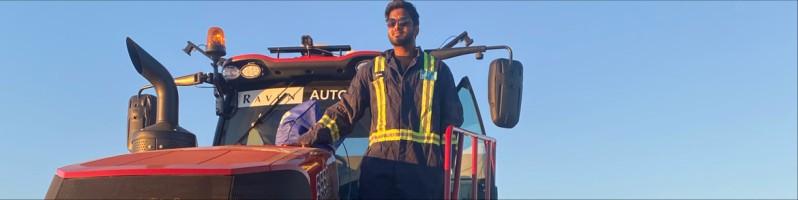
- My work at CNH began with a frustrating field behavior: machines were stopping too often in vegetation, dust, and uneven terrain. I rebuilt the perception flow as FalconEye V2, giving camera, LiDAR, radar, stereo, and vehicle-state inputs a shared language and producing far more stable fused tracks.
- 3D SurroundView started with a simpler moment—trying to maneuver a large articulated machine with mirrors alone. A two-week POC grew into a production architecture with calibrated cameras, bowl-mesh projection, seamless blending, articulation compensation, and display integration.
- The projection was only half the story. To make calibration repeatable outside the lab, I connected overlapping ChArUco observations into a guided workflow that test, factory, and field users could actually follow.
- After a small stopping-logic issue exposed a larger validation gap, I built a software-in-the-loop Safety Test Bench. Known field data now becomes a growing library of replayable scenarios, measurable KPIs, and regression gates before release.
- More recently, I’ve been refining stereo point clouds, ground planes, and obstacle processing so plant-to-ground localization can stay useful through terrain changes, vibration, and calibration drift.
- Across these systems, I treat sensor selection as a product decision rather than a spec-sheet contest—balancing range and density with calibration effort, environmental robustness, integration cost, and what downstream autonomy actually needs.
Research Assistant
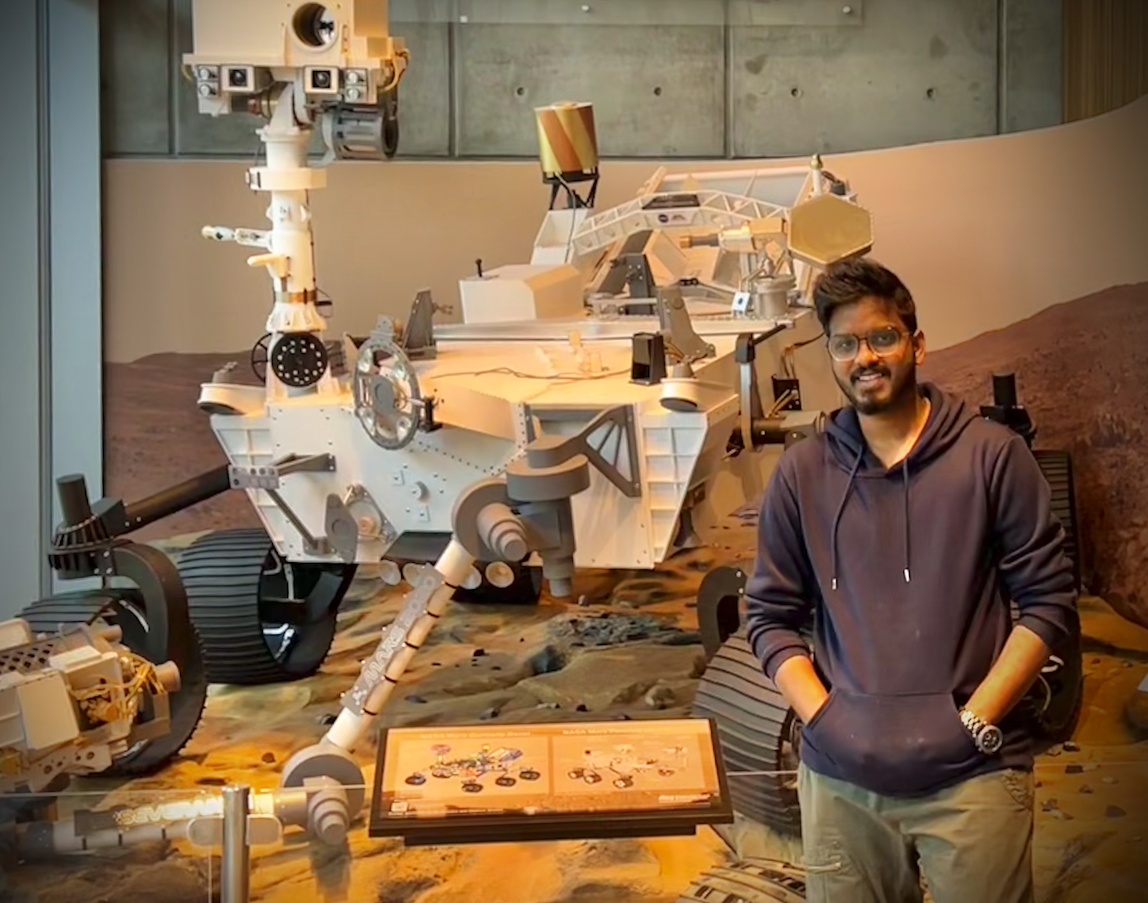
- Graduate school became my place to connect the whole robot, not just one model. With AERO, I brought detection (75% AP), tracking (90% accuracy), and segmentation (92% accuracy) into one autonomous exploration system.
- The robot also needed to judge distance with modest hardware, so I fused 2D LiDAR, ultrasonic sensors, and cameras—improving depth estimation accuracy by 30%.
- When planning became the bottleneck, Hybrid A* reduced computation time by 25% while preserving useful paths through complex spaces.
- A Tello drone became another playground for the perception-to-action loop: object detection, optical-flow tracking, gesture control, and PID behavior all had to work together in real time.
Computer Vision Engineer
- This is where I learned that computer vision becomes interesting when the image is only one piece of a machine. A fruit-color problem led me to a lossless spherical-to-image projection approach that the organization took into patent paperwork.
- Tight hardware budgets pushed me to rethink YOLOv4 for CPU deployment, reaching ~40% mAP at 100 fps on standard hardware.
- A drifting load-cell signal became a regression-based anomaly detector with 0.0241 MSE—a useful reminder that not every valuable ML problem needs a deep network.
- Repeated model tuning was slowing the team down, so I built an AutoML image-classification workflow that made fine-tuning roughly 7× faster.
Projects
Ideas I couldn't leave alone.
Some began as coursework, others as side-project questions. Each became a reason to connect algorithms, interfaces, and people into something that could actually be used.
K
AI-Native Filmmaking Platform
AI-Native Filmmaking Platform
2026 · Personal product
Karta
Karta began with a frustration: AI video tools could make impressive clips, but not a coherent film. I designed a workflow that carries an idea through scenes, persistent characters, storyboards, shot review, video and audio generation, versioning, and a final timeline.
Concept → storyboard → shot editor → finished film
R
Multi-agent AI Research System
Multi-agent AI Research System
Apr 2026 – Present · Side project
ResearchSquid
ResearchSquid began as a question: what if an AI research system worked more like an institute than a chatbot? A Program Director shapes the agenda, Scientist agents pursue shared work, and Neo4j plus pgvector preserve what the team discovers.
Multi-agent · Graph memory · Docker sandbox execution
Gesture & Vision-Controlled UAV
Dec 2021 – Apr 2022 · ASU Research Assistant
Autonomous Tello Drone
I wanted a small drone to understand more than a joystick. The Tello learned to follow faces, read body and hand gestures, detect objects, back away from close obstacles, and turn perception into motion through PID control.
★44 GitHub stars · 7 forks
FK/IK Simulation & Body Control
Aug 2021 – Dec 2021 · ASU · MAE 547
Quadruped Robot
A walking robot made kinematics feel tangible. I built a 12-DOF quadruped simulation from DH parameters, inverse kinematics, Jacobians, and body-frame transforms, then made every translation and rotation controllable in real time from the keyboard.
MAE 547 · ASU Robotics
GAIL on CarRacing-v2
Aug 2021 – Dec 2021 · ASU · EEE598
Inverse Reinforcement Learning
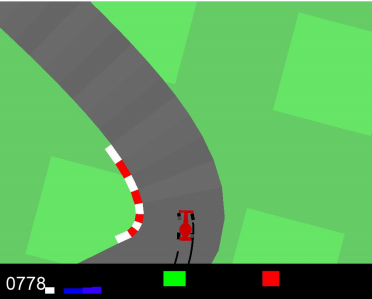
Instead of telling a driving agent what “good” looks like with a hand-built reward, I asked whether it could learn by watching. In CarRacing-v2, GAIL used expert trajectories and a discriminator to turn imitation into driving behavior.
Inverse RL · No explicit reward
SLAM + Object Detection in Complex Environments
Jan 2022 – May 2022 · ASU Research Assistant
AERO — Autonomous Explorer Bot
AERO was my attempt to build a robot that could enter an unfamiliar space and make sense of it without GPS. It mapped, localized, planned, detected people and objects on CPU-only hardware, and eventually moved from Gazebo into a physical robot I could test and debug.
Hardware prototype · Real SLAM
Low-Cost EEG Cursor Control
Apr 2022 · Independent neural-interface demo
Cursor Controlling Using Brain-waves
This began with a simple accessibility question: could an inexpensive headset replace part of a mouse? I decoded attention, meditation, and eye-blink signals from a NeuroSky MindWave and mapped their combinations into cursor actions.
Independent demo · Full PhD funding offer for neural-interface research
DP
Visual Deep Learning Model Builder
Visual Deep Learning Model Builder
May 2021 · Personal ML tooling project
Deep Playground
Before visual ML builders became common, I imagined model design as a graph you could touch. Deep Playground explored drag-and-drop layers, dynamic paths, one-click compilation, generated TensorFlow code, saved workflows, cloud export, and live training feedback.
Personal project · ML tooling
Master's Thesis
Multi-Robot Coordination in Unstructured Environments
Arizona State University · 2022 · Advised by Prof. Dr. Sangram Redkar
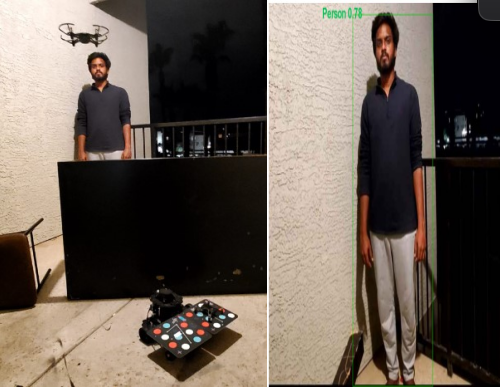
The thesis began with a limitation: a ground robot can search for a long time, but a blocked path can stop it completely; a drone can see beyond the obstacle, but cannot stay airborne forever. I built a coordinated system where the UGV navigates and searches, then calls an available UAV to inspect places it cannot reach.
State Estimation
Bayes filter, Kalman filter, Extended Kalman Filter for robot localization
SLAM & Navigation
ROS Gmapping occupancy grid, AMCL localization, Dijkstra + A* path planning
UAV AI Capabilities
MediaPipe Pose (33 3D landmarks) + KNN for body gesture control; 21 3D hand landmarks for gesture recognition
Object Detection
YOLOv4 on UGV and UAV for real-time human detection and object identification
Swarm Architecture
Decentralized multi-drone coordination with Mission Pad support; trajectory planning UI with collision-free paths
Hardware Prototype
Custom UGV with RPi 4B, Arduino Mega, RPLidar A1, L298N motor drivers, 12V DC motors + encoders
UGV-UAV Coordination
6-state decentralized state machine for seamless task handoff between ground and aerial robots
Thesis system overview
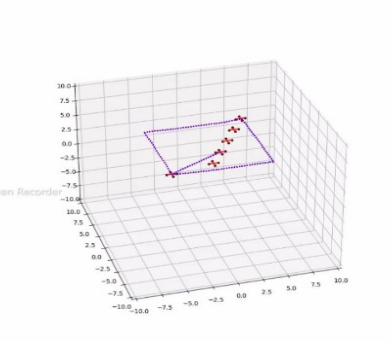
Multi-robot coordination workflow
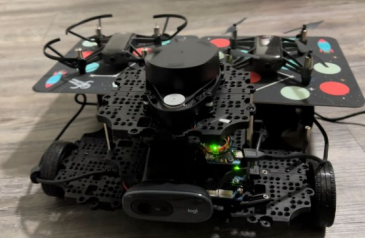
UGV and UAV navigation stack
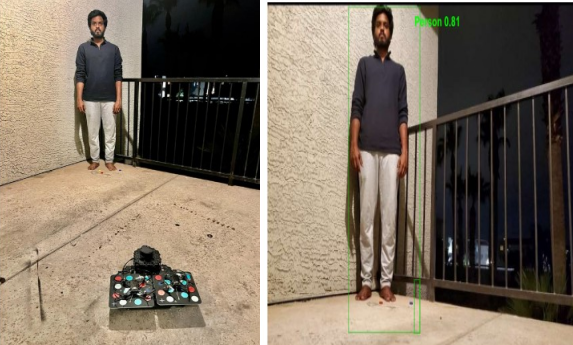
Gesture and perception pipeline
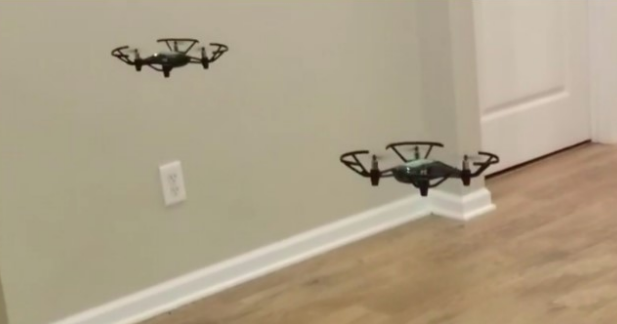
Search and rescue demo results
Research & Coursework
Questions worth chasing.
These studies were less about collecting methods and more about learning where they work, where they fail, and what a robot needs from them.
MAE 547 · ASU · Jan–May 2022
Crowd-Aware Robot Navigation
A shortest path can still be the wrong path when people are involved. I explored attention-based deep reinforcement learning that lets a robot weigh human-human and human-robot interactions before choosing how to move through a crowd.
EEE 511 · ASU · Aug–Dec 2021
StackGAN-v2: Text-to-Image
I wanted to understand how a sentence becomes an image—and where that translation breaks. Running StackGAN-v2 on bird descriptions made interpolation, inception scores, failure cases, and mode collapse visible rather than theoretical.
SES 598 · ASU · Jan–May 2022
Local Path Planning for Self-Driving
A global route is only a promise; nearby obstacles can invalidate it in a moment. I studied how cubic paths, Voronoi geometry, and VFH-style fallbacks can reshape a vehicle’s plan while it is already moving.
Skills
What I reach for.
The tools change with the problem. The throughline is systems thinking—from the sensor and coordinate frame to the interface, test, and behavior downstream.
Languages
Perception & State Estimation
Systems & Validation
Frameworks & Tools
Also familiar with
MediaPipeGmapping SLAMDJI Tello SDKA*EKFAMCLAutowareLMDeployHuggingFaceEducation
Where curiosity found structure.
Formal study gave me the mathematics and language for ideas I had already started exploring by building.
Aug 2021 – Dec 2022
M.S. Robotics and Autonomous Systems
Arizona State University
Tempe, Arizona
4.0 / 4.0
GPA
Thesis
"Multi-Robot Coordination in Unstructured Environments"
2015 – 2019
B.Tech Electronics & Communication Engineering
NIT Nagpur
Nagpur, India
Thesis
"GANs for Semi-Supervised Image Classification (F1: 0.95)"
Life beyond the stack
DIY AI & Robotics
Tinkering after hours
3D Printing
From CAD to part
Travel
New places, new ideas
Cooking
Recipe iteration
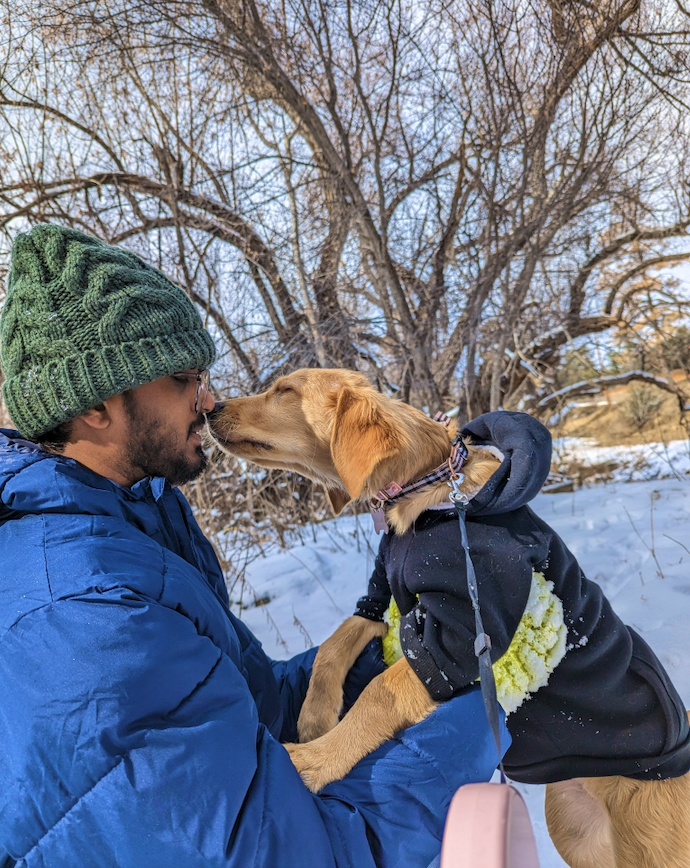
Tara
My walking buddy
Contact
Have a hard problem?
If you’re working on a machine that needs to perceive, decide, or behave more reliably in the real world, I’d love to hear the story behind it.